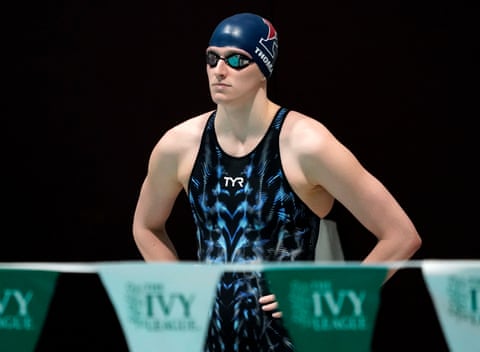
The University of Pennsylvania has agreed to ban transgender women from its women’s sports teams to resolve a federal civil rights case that found the school violated the rights of female athletes.
The US Education Department announced the voluntary agreement Tuesday. The case focused on Lia Thomas, the transgender swimmer who last competed for the Ivy League school in Philadelphia in 2022, when she became the first openly transgender athlete to win a Division I title.

It’s part of the Trump administration’s broader attempt to remove transgender athletes from girls’ and women’s sports.
Under the agreement, Penn agreed to restore all individual Division I swimming records and titles to female athletes who lost out to Thomas, the Education Department said. Penn also agreed to send a personalized apology letter to each of those swimmers.
It wasn’t immediately clear whether Thomas would be stripped of her awards and honors at Penn.
The university must also announce that it “will not allow males to compete in female athletic programs” and it must adopt “biology-based” definitions of male and female, the department said.
Education secretary Linda McMahon called it a victory for women and girls.

“The Department commends UPenn for rectifying its past harms against women and girls, and we will continue to fight relentlessly to restore Title IX’s proper application and enforce it to the fullest extent of the law,” McMahon said in a statement.
The Education Department opened its investigation in February and concluded in April that Penn had violated Title IX, a 1972 law forbidding sex discrimination in education. Such findings have almost always been resolved through voluntary agreements. If Penn had fought the finding, the department could have moved to refer the case to the Justice Department or pursued a separate process to cut the school’s federal funding.
In February, the Education Department asked the NCAA and the National Federation of State High School Associations, or NFSHSA, to restore titles, awards and records it says have been “misappropriated by biological males competing in female categories.”
The most obvious target at the college level was in women’s swimming, where Thomas won the national title in the 500-yard freestyle in 2022.
The NCAA has updated its record books when recruiting and other violations have stripped titles from certain schools, but the organization, like the NFSHSA, has not responded to the federal government’s request. Determining which events had a transgender athlete participating years later would be challenging.
At this dangerous moment for dissent
I hope you appreciated this article. Before you close this tab, I wanted to ask if you could support the Guardian at this crucial time for journalism in the US.
When the military is deployed to quell overwhelmingly peaceful protest, when elected officials of the opposing party are arrested or handcuffed, when student activists are jailed and deported, and when a wide range of civic institutions – non-profits, law firms, universities, news outlets, the arts, the civil service, scientists – are targeted and penalized by the federal government, it’s hard to avoid the conclusion that our core freedoms are disappearing before our eyes – and democracy itself is slipping away.
In any country on the cusp of authoritarianism, the role of the press as an engine of scrutiny, truth and accountability becomes increasingly critical. At the Guardian, we see it as our job not only to report on the suppression of dissenting voices, but to make sure those voices are heard.

Not every news organization sees its mission this way – indeed, some have been pressured by their corporate and billionaire owners to avoid antagonizing this government. I am thankful the Guardian is different.
Our only financial obligation is to fund independent journalism in perpetuity: we have no ultrarich owner, no shareholders, no corporate bosses with the power to overrule or influence our editorial decisions. Reader support is what guarantees our survival and safeguards our independence – and every cent we receive is reinvested in our work.
The Guardian’s global perspective helps contextualize and illuminate what we are experiencing in this country. That doesn’t mean we have a single viewpoint, but we do have a shared set of values. Humanity, curiosity and honesty guide us, and our work is rooted in solidarity with ordinary people and hope for our shared future.
It has never been more urgent, or more perilous, to pursue reporting in the US that holds power to account and counters the spread of misinformation – and at the Guardian we make our journalism free and accessible to all. Can you spare just 37 seconds now to support our work and protect the free press?